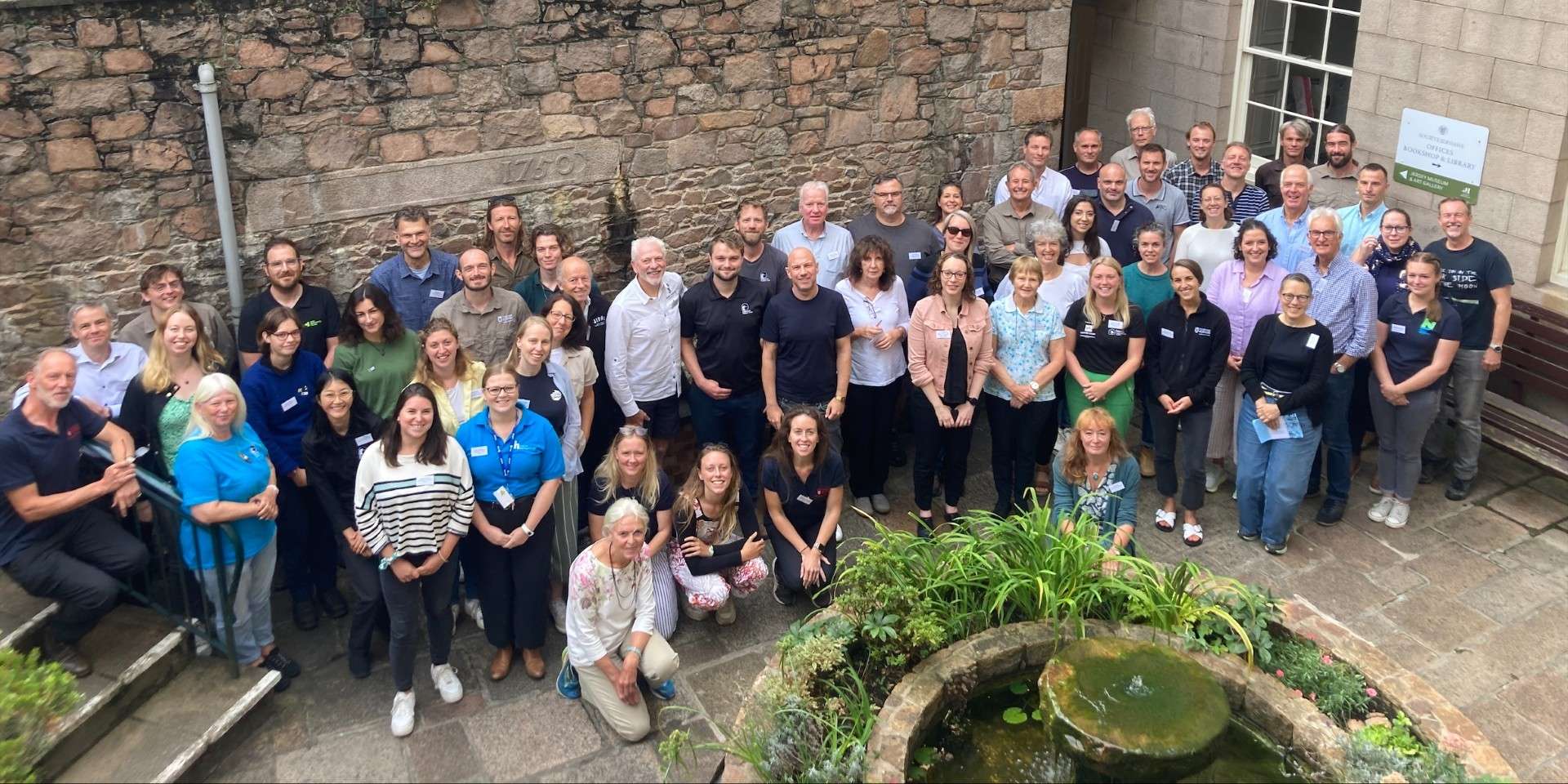
The 24th Inter-Island Environment Meeting was held at the Société Jersiaise, St Helier, Jersey, on the 5th and 6th of September 2024.
Download the 2024 IIEM Conference Agenda and Events Programme
Day 1 – Thursday 5th September 2024
Session 1 – State of Nature and Strategy
Alderney’s Seabirds: Flying drones and filming puffins to build long-term datasets.
Alex Purdie, Alderney Wildlife Trust
Seabirds are a keystone of Alderney’s natural environment, pivotal to five qualifying criteria of the island’s Ramsar Site. Nineteen years of Ramsar has seen States of Alderney funded monitoring of breeding seabirds. This talk will dive into two of the most famous of these: Atlantic puffin and northern gannet and the population trends of the other seabirds breeding around Alderney. It will cover new, and old, monitoring methods, and the value of these long-term datasets and the Ramsar programme which underpins them.
Presentation slides (pdf)
The Alderney State of Nature project
Tara Cox, Alderney Wildlife Trust
Matt Lewis, Alderney Wildlife Trust
For over twenty years, the Alderney Wildlife Trust has collected baseline data on Alderney’s natural environment. In 2023, the AWT launched the Alderney State of Nature project to use this data to understand how key species and habitats have changed over time, with the aim of ensuring that its conservation work is best targeted to the most important and effective actions.
This talk will give an overview of the project, focusing on the process to produce a list of key species and habitats of conservation concern, as well as economic and cultural importance to Alderney’s community. The outputs from the project will be publicly available, and meet several objectives of the States of Alderney’s Strategy for Nature and Agriculture. Through embedding community views throughout the project, we hope to build a sense of ownership in understanding how the natural environment is changing, and how anyone can help through both biological recording and conservation action.
Presentation slides (pdf)
Guidance under the Wildlife (Jersey) Law 2021
Lindsey Napton, Land Resource Management, Government of Jersey
Holly Maynard, Land Resource Management, Government of Jersey
The Wildlife (Jersey) Law 2021 provides different levels of protection for Jersey’s wildlife, as a reflection of species’ local and international conservation status. For example, in the case of the Grass snake, one of our rarest species, protection is provided not only of their den but also of the wider breeding and resting sites upon which this species depends. The implications of these varied levels of protection for anyone working with wildlife can be complex to understand.
The Land Resource Management team has published guidance notes providing a practical interpretation of what key terms such as breeding sites, resting sites and disturbance mean in practice when applied to different species or species groups. Further guidance is planned. The challenge is to ensure such guidance meets the needs of a wide target audience and is then communicated effectively for the benefit and conservation of Jersey’s wildlife.
Presentation slides (pdf)
Guernsey 2020 Strategy for Nature into action
Jessi Jennings, Guernsey Nature Commission
Charlotte Burgoine, Guernsey Nature Commission
Julia Henney, States of Guernsey
Delivery of the Guernsey 2020 Strategy for Nature into action. The vision of the States of Guernsey 2020 Strategy for Nature is ‘Guernsey’s nature; great today, better tomorrow’, and its purpose is to ensure that Guernsey’s nature is healthy and resilient to threats and understood and valued for its essential contribution to our sustainable economy, community, and health and care. The Nature Commission provides support in the delivery of the Strategy for Nature and has over the past year been implementing workstreams to help progress against the objectives in the Strategy. This presentation will share some of the workstreams underway, provide a brief overview of the challenges encountered, and outline some of the plans for the future.
Presentation slides (pdf)
The Manx Wildlife Trust strategy
Leigh Morris, Manx Wildlife Trust
The Manx Wildlife Trust strategy is strongly aligned with three key documents: the Isle of Man Government’s Biodiversity Strategy, The Wildlife Trusts Strategy 2030, and the Global Biodiversity Framework, which came out of COP 15. Leigh’s talk will explain how the MWT team are focused on playing our part in delivering these overarching strategies, and contributing well to the Island’s UNESCO Biosphere status.
Presentation slides (pdf)
Session 2 – Indicators and Invasives
INNS mosquito surveillance
Nathan Hayes, Biosecurity, Government of Jersey
Mosquitoes are the most significant insect vectors of disease worldwide, best known for their biting nuisance and malaria. This short presentation will discuss mosquitoes as vectors of disease in an ever-globalised world with a warming climate. The presentation will cover:
- The biology of mosquitoes
- The most significant mosquitoes in relation to disease transmission
- How globalisation and climate change are impacting the spread of mosquitoes
- Invasive mosquito distribution and disease transmission in Europe
- Invasive mosquito monitoring in Jersey
Presentation slides (pdf)
INNS Action Plan
Julia Henney, States of Guernsey
The INNS Action Plan for Guernsey (2023) prioritised the prevention of introduction and establishment of new INNS, in line with EU and UK guidance. The States of Guernsey have turned this into action by undertaking a horizon scanning exercise to identify species of significant concern for the island. From this long list a Top 10 ‘alert’ list has been developed, which can be used across the Channel Islands to encourage awareness and reporting of high-risk species and in turn, help prevent their establishment in the islands.
eDNA monitoring of coastal ecosystems
Jean-Luc Jung, Dinard Marine Station
Coastal areas play a vital role as habitats for many species, but are under increasing anthropogenic pressure. Environmental DNA (eDNA) metabarcoding offers relevant, non-invasive solutions for monitoring marine biodiversity, complementing existing approaches. In a pilot study, we explored vertebrate diversity in the coastal and estuarine areas of the Rance (the large river between Saint-Malo and Dinard, in north-western France). A total of 124 different taxa were detected. Taxonomic compositions differed from one sampling site to another, but stable taxonomic richness and phylogenetic diversity were observed along the estuarine gradient. The ease of implementation and the results obtained by eDNA metabarcoding, strongly consistent with previous studies, reinforce the interest of this approach for the biomonitoring of estuarine and coastal ecosystems.
Presentation slides (pdf)
Session 3 – Engagement and Cooperation
Playing our way into potential
Ali Hodgson, Manx Wildlife Trust
How to deliver strategy and influence policy makers and the public through creativity, systems thinking and games for change. What can we gain from tapping into the creative industries as a way to implement (or even help design) our environmental strategies, gain public and political buy-in and help influence whole-system change in the face of complex ecosystemic challenges?
Join Ali Hodgson, the current Isle of Man Biosphere Artist in Residence (a year-long recurring program in partnership with Manx Wildlife Trust and UNESCO Biosphere Isle of Man) in exploring these issues through both the role of the artist and social designer, and the development of her REIMAGINING our Biosphere project; a customisable bioregional game and facilitation method designed to help people of all ages and sectors to develop their capacity to collectively reimagine our future whilst taking into account the whole human/ecological system we are part of.
Presentation slides (pdf)
Little islands, big responsibility: Introducing project Pelagicus
Adrien Lambrechts, Office Français de la Biodiversité
Cris Sellares, The National Trust for Jersey
This talk examines how the action plans for the rarest seabird in the Mediterranean are being implemented in the Channel Islands. The Spanish strategy of conservation for the Balearic shearwater, approved in 2005, was followed by the international species action plan in 2011, and France’s National Action Plan in 2021. In the meantime, various national and European projects have been established to fund research and conservation of the species. The implementation of this species action plans has landed on the Channel Islands via the Office Français de la Biodiversité, prompting a new inter-regional research initiative that has the potential to yield great benefits for the wildlife of both Bailiwicks.
Presentation slides (pdf)
End of life fishing gear recycling scheme
Alex Plaster, Marine Resources, Government of Jersey
This is a collaborative project between Marine Resources, Ports of Jersey, Solid Waste, Jersey Fishermen’s Association and the Jersey Prison Service. Previously fishers were unable to recycle or dump their end-of-life fishing gear due to the pots and nets consisting of mixed materials. Jersey Prison Service are now breaking down the equipment so the materials can either be recycled, re used or incinerated. Lost and discarded fishing gear represents a large portion of waste collected in beach cleans globally. This project is helping to reduce pollution in the marine environment and to keep the harbour areas looking tidy and professional. Jersey is working to a point where there is enough recyclable material to make it economic to explore recycling possibilities.
Presentation slides (pdf)
International cooperation
Laurent Guerin, Dinard Marine Station
A new initiative to help improve scientific communication in local communities and across the channel has recently been formed. The goal of this initiative is to create a channel of communication, initially between Jersey and France, but overtime to include other jurisdictions, and to improve education around environmental issues, starting with marine litter. This will first be run as a schools competition but will, in time, expand out to general public events and exhibitions.
Discussion Sessions
During the afternoon of day 1 of the meeting, delegates selected one of the following discussion sessions to participate in:
- IIEM steering committee – to decide if a committee is needed and, if so, the best forum for this committee and representatives from each island/jurisdiction.
- Carbon literacy – how do we reduce our climate emissions in line with the Carbon Neutral Roadmap.
- International cooperation – cross-jurisdictional working, with a focus on science communication through media and art that is accessible on all sides of the channel.
- Effectively communicating invasive non-native species actions to the general public.
- Ramsar – current management and future priorities.
Workshop
How do you communicate your messages beyond the bubble?
Martin Bloxham, Barefoot thinking
A key challenge facing many working in the environmental sector is the ability to clearly communicate and engage with multiple audiences to ensure engagement, buy-in and, ultimately, co-operation and collaboration between stakeholders and interest groups. In essence – how do you communicate your messages beyond the bubble? And what message do you need to convey to get them on board?
During this 2-hour interactive workshop, participants reflected on their communication situations and challenges. The sessions covered key elements of effective communication, such as setting clear goals and objectives, devising strategies, and using storytelling to reach the intended audience with simple, clear messaging.
Day 2 – Friday 6th September 2024
Session 1 – Community
Community organising in the Isle of Man
Hannah Phillips, Manx Wildlife Trust
The Team Wilder ethos is a collective shift within The Wildlife Trusts to use community organising practices to help achieve our shared vision of a wilder future. This work is central to The Wildlife Trust’s 2030 strategy particularly regarding the goal to have more people taking action for nature. It is also strongly reflected in the strategic transformation aim outlining the desire to inspire community organising and mobilising. This presentation will outline how Manx Wildlife Trust are using community organising practices to help conserve and enhance Manx Wildlife, through community led action.
Presentation slides (pdf)
Getting to the finish line: from policy to reality
Alan Le Maistre, The National Trust for Jersey
Cris Sellares, The National Trust for Jersey
From the Atlantic Puffin Jersey Action Plan to the Plémont Ecosanctuary project, via the Biodiversity Strategy, the Jersey Bridging Island Plan, and various international conventions, we present how the conservation of one species can benefit protected habitats and human communities, as well as the challenges of balancing local policies with the will of a community.
What about Risso’s Dolphins?
Juliette Biacchi, AL LARK
AL LARK, an NGO in Cancale, Brittany, focuses on marine conservation and research, particularly through citizen science. The presentation highlights the challenges of studying Risso’s dolphins, notably their exclusion from coastal management plans and limited sightings. Addressing these issues requires collaboration, such as creating and sharing photo ID catalogs, using land-based observations, and analyzing strandings and other available data. AL LARK also plans to launch a PhD project with the French Biodiversity Agency and La Rochelle University to enhance conservation efforts. The NGO envisions establishing a European network to share information and foster collaboration among researchers and organizations working on Risso’s dolphins.
By addressing these challenges and proposing solutions, the presentation seeks to encourage discussion and cooperation among stakeholders to improve the understanding and conservation of Risso’s dolphins.
Presentation slides (pdf)
Community work, research and political engagement
Freddie Watson, Blue Marine Foundation
Blue Marine’s mission is to see at least 30 per cent of the world’s oceans under effective protection by the year 2030. Since the start of our involvement on the Island in 2018, we have been involved in collaborative research, education and outreach, supporting low-impact fisheries and running MPA campaigns. This talk will provide a high level insight into the importance and relevance of these different strands of work, while tying in the policy context and outlining how all of this fed into the inclusion of MPAs within the development of the Marine Spatial Plan.
Presentation slides (pdf)
Session 2 – 30×30 and Conservation Measures
The Jersey Marine Spatial Plan and its role in achieving 30×30
Sam Blampied, Marine Resources, Government of Jersey
The first Marine Spatial Plan for Jersey has been a community led document, with stakeholders in the marine environment having been consulted before the first draft of the plan had been written. The MSP sets out a roadmap for the next 5-10 years regarding the spatial management of our marine resources. It considers all users of the marine environment, from recreational users to industry and tourism, to cultural heritage and energy security.
There are proposals in the MSP to expand our current marine protected area network of 6.5% of Jersey’s waters to encompass over 23%. While this falls short of the required 30%, it will protect the most sensitive habitats from mobile fishing. This talk will summarise the journey taken to get to this point.
Presentation slides (pdf)
Can Sark participate in the “30 x 30” initiative?
Carol Cragoe, La Société Sercquaise
Sark’s diverse range of natural and marine habitats is appreciated by residents and visitors, but there is only one officially protected area: the 4ha Ramsar site covering the Gouliot cave system and the lower parts of the Gouliot headland. The existing Sark legislation has no specific mechanisms for nature protection. Benign neglect has played an important part in preserving Sark’s natural environment, but unsympathetic development has also highlighted the limitations of this system.
La Société Sercquaise has begun exploring how Sark might join in the global “30 x 30” initiative which aims to formally protect and effectively manage 30% of land and marine areas for nature by 2030. This paper will look at some of La Société’s initial efforts identifying key habitats and its discussions with stakeholders about their concerns. It will also present some initial thoughts on how protection might be achieved either through adaptation of existing legislation or with new legislation.
Presentation slides (pdf)
Umbrellas and chaos
Kevin McIlwee, Jersey Marine Conservation
The presentation will discuss three of the principle aims of the MSP and associated factors from the perspective of an island-based NGO, charity organisation. We will look at gathering evidence, identifying significant habitats through umbrella and keystone species, examining key characteristics. Principle sites that act as stepping stones for species dispersion will be highlighted and briefly reviewed.
The talk will consider the MSP in relation to JMC’s observations on the impacts of climate change, examining model predictions, linking ground truthing surveys, highlighting the strengths, limitations and analysis/ use of the data obtained. Focus will be on specific investigations of vulnerable species such as Eunicella verrucosa and Zostera marina that function as umbrella and keystone species. The final section will be a brief examination of the implication of the MSP recommendations, in relation to the resources and role played by Jersey Marine Conservation.
Presentation slides (pdf)
MPA’s in the French Normano-Breton Gulf
Laure Ducommun, DREAL Normandie
The Normano-Breton Gulf is home to various marine protected areas that are part of either the European network of Natura 2000 sites or the international network of RAMSAR sites. These offshore and coastal sites include a wide range of protected habitats or species, leading to the management and regulation of socio-economic activities with harmful effects on biodiversity. The aim of this presentation is to present the different MPAs present in the Normano-Breton French Gulf, their progress and the different actors involved in their management.
Presentation slides (pdf)
Aspiring Jersey Island Geopark UNESCO application in 2025 for full geopark status
Paul Chambers, Jersey Heritage
The aspiring Jersey Island Geopark (aJIG) recognises, celebrates and promotes our Island’s extraordinary geoheritage. The project was started by Jersey Heritage in 2016 with the objective of obtaining full UNESCO Global Geopark (UGGp) status for the Bailiwick of Jersey. To achieve this non-statutory designation, Jersey will need to demonstrate that the aJIG has a bottom-up and holistic approach to numerous criteria covering including sustainable development, partnerships, conservation, geotourism and education. As a Crown Dependency, Jersey can only apply for full UGGp status through the United Kingdom government (UKG) via its UNESCO National Commission. This situation applies to other environmental international agreements (EIAs) such as OSPAR, Ramsar, CBD, CITES, etc. This talk will present an update on the aJIG’s application progress to UNESCO and the implications of international designation applications made through the UKG.
Presentation slides (pdf)
Inter-Island Environment Meeting 2025 – Isle of Man
At the end of the meeting, Leigh Morris, CEO of the Manx Wildlife Trust, provided an update on the plans for IIEM 2025.
The next Inter-Island Environment Meeting will be held on the 17 and 18 September 2025 at the Manx Museum, Douglas, Isle of Man.
The full IIEM 2025 events programme, including additional site visits and themed workshop sessions, is scheduled to run from the 15th-19th September 2025.
Subscribe to the IIEM email list to receive the latest news and updates about IIEM 2025 and upcoming conferences in your inbox.
Excursions
Following the meeting, delegates had the opportunity to discover more about Jersey’s wildlife on one of the following excursions:
- Snorkel trail at Portelet No Take Zone.
- A Wetland Wander in St Ouen’s.
- Rib tour to Les Ecréhous.
- Meet the Collections at Jersey Museum.
- Société Jersiaise library, herbarium and entomology collections.
N.B. All copyrights relating to the materials provided and linked to on this page remain entirely with the originators. If you wish to reproduce the content or images provided, please contact the originator directly.
